***** Please find the Attachment below for download*****
SERICULTURE PROFILE AND STATUS OF MIZORAM 2024 - 2025
CONTENT
Particulars | Page No |
Map of Mizoram | 3 |
Mizoram at a glance | 4-6 |
Manpower/Staff strength | 7 |
Sericulture in Mizoram - priority arear, production-wise District Rank, District-wise priority of Sericulture in Mizoram in terms of production. | 8 |
Sericulture villages of Mizoram, District-wise and sericulture farmers of Mizoram | 9 |
Sericulture village: Sector-wise farmers. The graphical presentation of farmers involved in Sericulture during 2024-2025 | 10 |
Physical progress. Year-wise silkworm food plant area during XII plan. The graphical presentation of silkworm food plant area during 2013– 2025. | 11 |
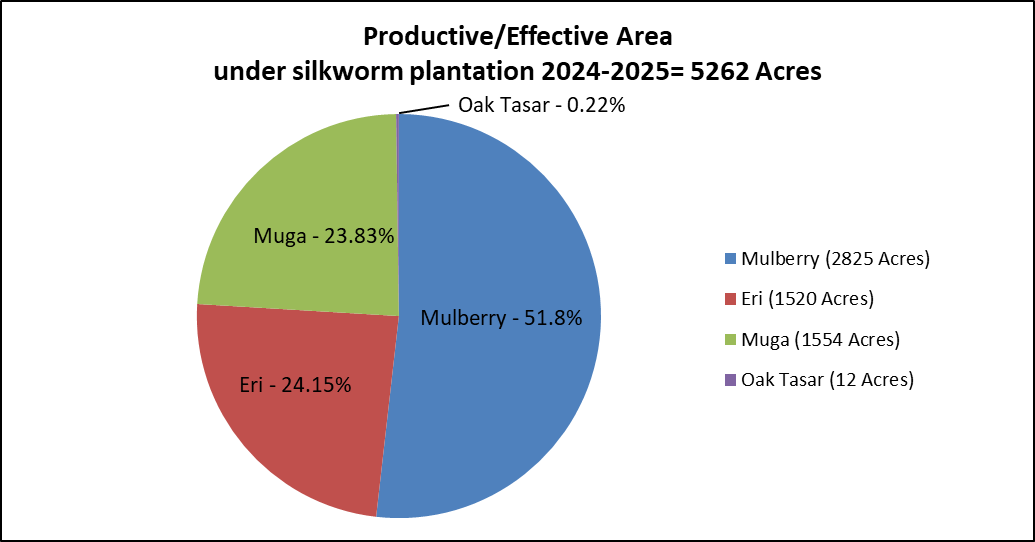
District-wise distribution of actual vis-a-vis effective areas. Productive/Effective Area under silkworm food plant 2024 - 2025. | 12 |
Physical target & Achievement 2024-2025. District wise Raw Silk Production of the year 2024-25. The consumption of dfls, Production of reeling cocoons and production of raw silk of Mizoram for the year 2024-2025. The graphical presentation of raw silk production during 2023 – 24
| 13-14 |
Raw Silk Production of state for last 5 years. Numbers of Active Reelers, Spinners, Weavers, Dyers and Spinning Mills. Employment generated in post cocoon sector. Productivity | 15-16 |
Infrastructure | 17 |
Seed production infrastructure facilities of Mizoram | 18-19 |
Financial Progress. Financial Allocation. | 20 |
Beneficiaries covered under different schemes of Govt of India | 21 |
Status of ongoing Sericulture Schemes by Govt. of India | 22 |
Govt. Approved rate of Sericulture products. | 23-24 |
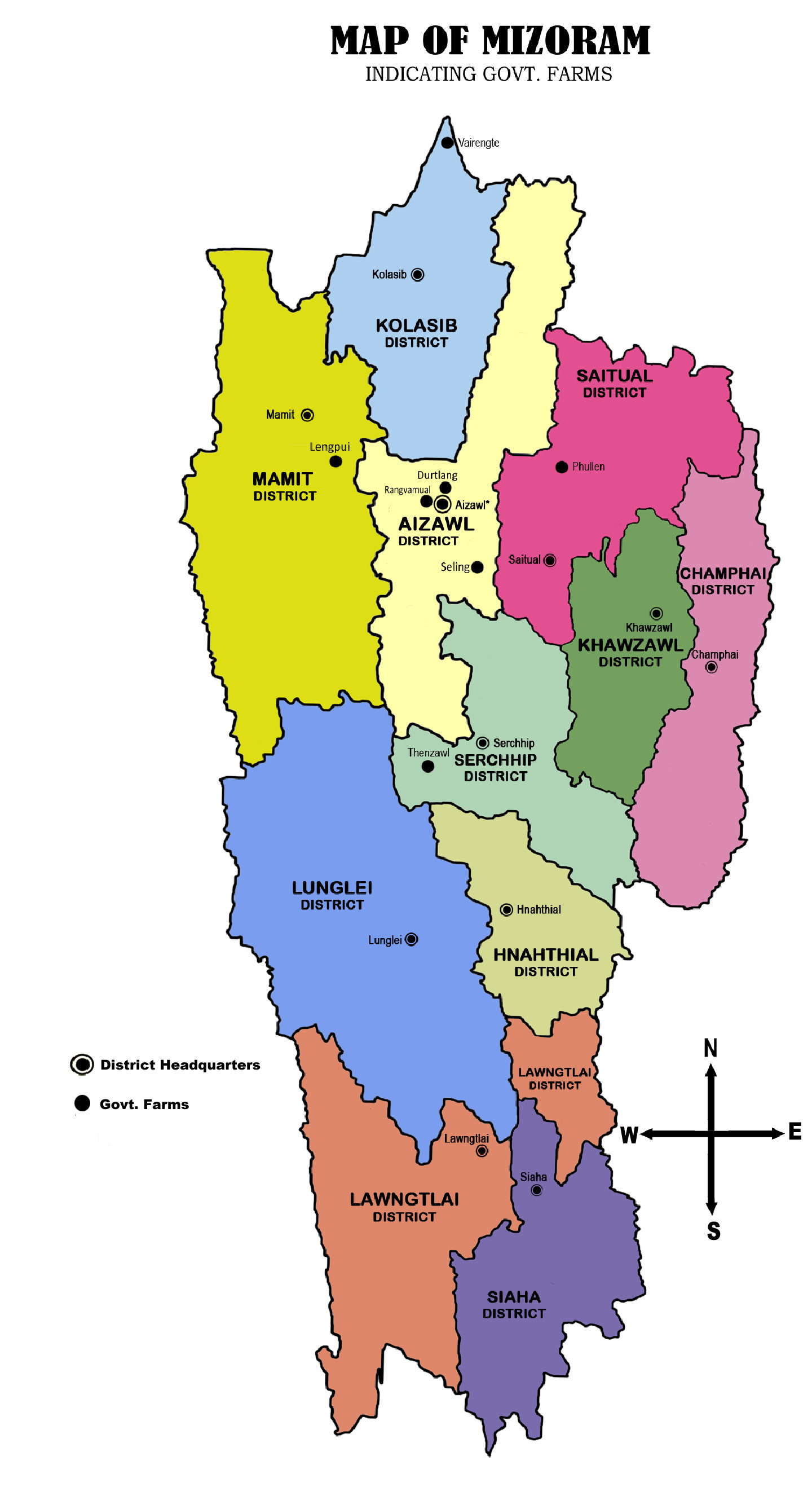
Mizoram at a glance:
1. Introduction
This report presents a comprehensive overview of the Indian state of Mizoram, focusing on its geographical characteristics, administrative structure, topography, climate, and the economic significance of sericulture.
2. Geographical Location and Strategic Importance
Mizoram became the 23rd state of the Indian Union in February 1987 and continues to play a vital role in India’s northeastern development strategy. Mizoram is located in the northeastern corner of India, sharing international borders with Myanmar to the east and south, and Bangladesh to the west. It is bordered by Tripura, Assam, and Manipur on the Indian side. Spanning a total area of 21,081 square kilometres, the state maintains a 630-kilometer-long international boundary, comprising approximately 318 kilometres with Bangladesh and 510 kilometres with Myanmar. Mizoram’s strategic location enhances its importance in India’s Act East Policy and in facilitating cross-border trade and connectivity.
3. Administrative Divisions and Demographics
The state comprises eleven administrative districts: Aizawl, Lunglei, Saiha (Siaha), Champhai, Kolasib, Serchhip, Lawngtlai, Hnahthial, Khawzawl, Saitual, and Mamit. According to the 2011 Census, Mizoram has a population of approximately 10.97 lakh (1.097 million), making it the least populous among the northeastern states of India.
4. Topography
Mizoram is characterized by a rugged hilly landscape interspersed with deep valleys. The numerous rivers that flow predominantly from north to south form gorges between the hills. The average altitude of the hill ranges is around 900 meters, with the state’s highest peak, Phawngpui (Blue Mountain), rising to 2,210 meters. This terrain contributes to Mizoram’s unique ecological and scenic identity, earning it the nickname “Land of the Blue Mountains.”
5. Climate
Mizoram experiences a moderate and pleasant climate. Summer temperatures range between 23°C and 29°C, while winter temperatures fall between 15°C and 23°C. The state receives significant rainfall due to the southwest monsoon, particularly between May and September. Aizawl, the state capital, records an average annual rainfall of around 208 centimetres.
6. Economic Activity: Focus on Sericulture
Sericulture plays a growing role in Mizoram’s rural economy. The Department of Sericulture, Government of Mizoram, currently operates with a staff of 305 personnel—130 technical, 73 non-technical, and 102 provisional employees—who are distributed across the Directorate, the Sericulture Training Institute (STI), and all 11 districts. The department supports sericulture activities in 211 villages, involving 5,339 farmers and spanning 5,911 acres of land under silk cultivation.
The state supports the cultivation of all four indigenous silk varieties: Mulberry, Eri, Muga, and Oak Tasar. Mizoram’s favourable agro-climatic conditions, high rainfall, and biodiversity are conducive to silkworm rearing. Despite its relatively small scale, sericulture has contributed significantly to employment generation, particularly among women and rural communities. Efforts by the Central Silk Board, the Ministry of Textiles, and the State Government—such as the North East Region Textile Promotion Scheme (NERTPS) and Silk Samagra II—have modernized practices, introduced improved silkworm breeds, and enhanced productivity through financial and technical support.
7. Opportunities
Sericulture in Mizoram presents substantial opportunities for economic development and employment generation. The state's natural conditions—including fertile soils, abundant rainfall, and a favourable climate—support year-round cultivation of all four silkworm species. With over 5,300 families already engaged across 211 villages, the sector has the potential to expand further as a key livelihood source in rural areas.
Government initiatives such as NERTPS and Silk Samagra II have laid a strong foundation by improving access to technical support, training, and financial assistance. The establishment of grainage centres and training institutions has further enhanced skill development and infrastructure capacity. These developments position sericulture as a sustainable agro-based industry with the potential to improve rural incomes, promote women’s empowerment, and contribute to Mizoram’s inclusive economic growth.
8. Challenges
Despite its promise, the sericulture sector in Mizoram faces a number of structural and operational challenges:
- Lack of Skilled Labor and Technical Knowledge: Many farmers lack formal training, resulting in suboptimal rearing practices and reduced productivity.
- Climate Change Impacts: Changing weather patterns affect mulberry cultivation and silkworm health, often leading to crop failures and inconsistent silk quality.
- Fragmented Land Holdings: Small and scattered land parcels hinder large-scale production and investment in infrastructure.
- Weak Market Linkages: A lack of organized marketing systems limits access to competitive markets and pricing transparency.
- Inadequate Infrastructure and Financial Support: Limited availability of state funds and underutilization of government schemes restrict investments in rearing houses, equipment, and staff recruitment.
Addressing these issues will require a holistic and coordinated approach involving both the state and central governments, with an emphasis on modern training, improved market systems, technology adoption, and infrastructure maintenance.
9. Future Prospects
With sustained policy support and strategic interventions, sericulture in Mizoram has the potential to evolve into a robust and sustainable industry. Key areas of focus for the future should include:
- Skill Development and Capacity Building: Expansion of training programs for farmers and youth to adopt advanced rearing techniques.
- Technology Integration: Adoption of innovative technologies in silkworm rearing, disease control, and post-cocoon processing.
- Infrastructure Strengthening: Upgrading existing grainage centres, rearing sheds, and storage facilities to support higher production.
- Market Development: Establishing cooperative marketing structures and direct linkages with silk buyers and exporters.
- Climate Resilience Measures: Introducing climate-resilient plant varieties and practices to mitigate the impact of environmental changes.
By investing in these areas, Mizoram can enhance the productivity and sustainability of its sericulture sector, transforming it into a major source of employment and economic resilience for its rural population.
Mizoram, though small in terms of population and land area, holds significant potential for strategic development. The state’s diverse topography, favourable climate, and emerging sectors like sericulture offer valuable opportunities for inclusive growth. With the right mix of infrastructure, policy support, and capacity building, Mizoram can strengthen its economic base and improve the quality of life for its rural communities—positioning itself as a model for sustainable development in the northeastern region of India.
Total Area | 21,081 sq.km
|
Geographical Location | 220 56´ N to 240 32´ N latitude & 900 09´ E to 920 20´ E longitude.
|
Climate | 11 0 C (winter) to 290 C (summer)
|
Population | 1,091,014 (male- 5,52,339 and female- 5,38,675) as per 2011 census
|
Boundary | East – Myanmar, West- Bangladesh and Tripura North- Assam and Manipur, South- Myanmar
|
Density of population | 52 per sq.km
|
Topography | Varied landscapes ranging from hills to plains
|
Total Literate(literacy)
| 8,48,175 (91.33%)
|
Manpower/Staff strength:
The Sericulture Department of Mizoram is functioning under the control of Director of Sericulture, Govt. of Mizoram. Presently, there are 203 nos of personnel employed in Sericulture Department of Mizoram as indicated below:
# | District | Manpower / staff (Nos) | |
Tech | Non-tech | ||
1 | Aizawl | 27 | 9 |
2 | Lunglei | 7 | 5 |
3 | Siaha | 7 | 2 |
4 | Champhai | 8 | 2 |
5 | Kolasib | 12 | 2 |
6 | Serchhip | 13 | 5 |
7 | Lawngtlai | 4 | 3 |
8 | Mamit | 4 | 4 |
9 | Khawzawl | 5 | - |
10 | Hnahthial | 7 | - |
11 | Saitual | 7 | 1 |
12 | S.T.I. | 15 | 11 |
13 | Directorate | 14 | 29 |
| Total | 130 | 73 |
| G.Total = | 203 | |
Posts vacant not mentioned
Sericulture in Mizoram:
Priority Areas:
# | Priority |
Mulberry | I |
Eri | II |
Muga | III |
Oak-tasar | IV |
Production-wise District rank in sericulture:
Sector | District Rank in Sericulture | ||
| I | II | III |
Mulberry | Champhai | Mamit | Aizawl |
Eri | Kolasib | Lawngtlai | Hnahthial |
Muga | Serchhip | Champhai | Saitual |
Oak-tasar | Champhai | - | - |
District-wise priority of Sericulture in Mizoram in terms of production:
# | District | I | II | III | IV |
1 | Aizawl | Eri | Mulberry | Muga | - |
2 | Lunglei | Eri | Mulberry | Muga | - |
3 | Siaha | Muga | Eri | - | - |
4 | Champhai | Mulberry | Eri | Muga | Oak Tasar |
5 | Kolasib | Eri | Muga | - | - |
6 | Serchhip | Muga | Eri | Mulberry | - |
7 | Lawngtlai | Eri | Mulberry | - | - |
8 | Mamit | Mulberry | Eri | Muga | - |
9 | Khawzawl | Mulberry | Eri | Muga | - |
10 | Hnahthial | Eri | Mulberry | Muga | - |
11 | Saitual | Muga | Eri | Mulberry | - |
Sericulture villages of Mizoram:
#
|
District
| Sericulture Village (No) |
1 | Aizawl | 20 |
2 | Lunglei | 49 |
3 | Siaha | 21 |
4 | Champhai | 14 |
5 | Kolasib | 13 |
6 | Serchhip | 10 |
7 | Lawngtlai | 9 |
8 | Mamit | 35 |
9 | Saitual | 15 |
10 | Khawzawl | 14 |
11 | Hnahthial | 11 |
| Total | 211 |
District-wise and sericulture farmers of Mizoram 2024-2025:
District | Sericulture Farmers
| Total | |||
Mulberry | Eri | Muga | Oak-tasar | ||
Aizawl | 383 | 121 | 152 | - | 656 |
Lunglei | 720 | 152 | 171 | - | 1043 |
Siaha | - | 18 | 418 | - | 436 |
Champhai | 225 | 134 | 46 | 12 | 417 |
Kolasib | 22 | 120 | 169 | - | 311 |
Serchhip | 90 | 63 | 90 | - | 243 |
Lawngtlai | 145 | 110 | 59 | - | 314 |
Mamit | 67 | 457 | 68 | - | 592 |
Saitual | 112 | 30 | 46 | - | 188 |
Khawzawl | 428 | 139 | 39 | - | 606 |
Hnahthial | 161 | 169 | 203 | - | 533 |
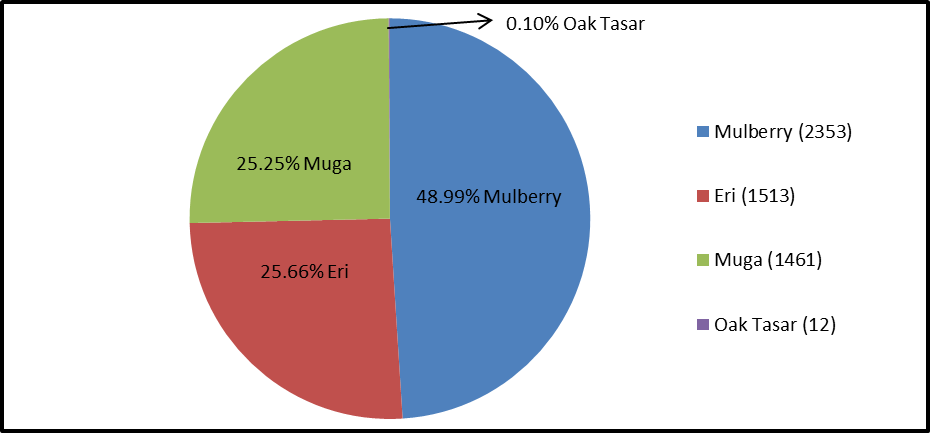
TOTAL | 2353 | 1513 | 1461 | 12 | 5339 |
Sericulture village: Sector-wise farmers:
A total of 4546 nos. of families are engaged in Sericulture activities in Mizoram Acre per farmers. Sector-wise break-up shown below:
Sector | Sericulture Farmers | Seri. Families (No)
| Seri. Villages (No)
|
Mulberry
| 2353 | 5339 |
211
|
Eri | 1513 | ||
Muga | 1461 | ||
Oak-tasar | 12 |
Farmers Involve in Sericulture during 2024-2025
Physical Progress:
A total of 5911 Acres of land covered under Muga, Eri, Mulberry and Oak-tasar silkworm food plant sector in Mizoram.
Sector | Food plant area |
Mulberry | 2825 Acres |
Eri | 1520 Acres |
Muga | 1554 Acres |
Oak-Tasar | 12 Acres |
Total | 5911 Acres |
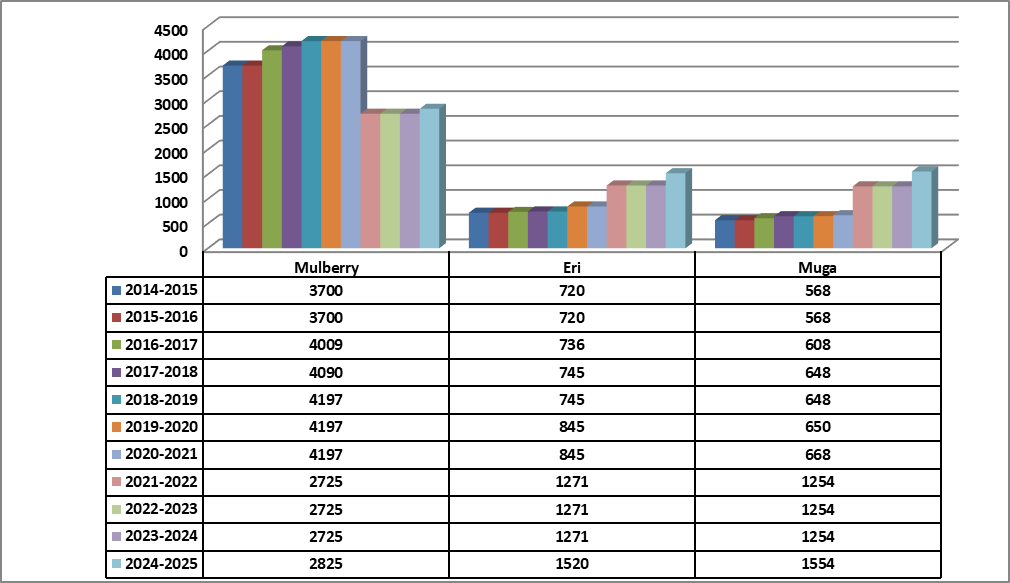
Year-wise silkworm food plant area during XII plan:
Sector | Area (Acres) |
|
| ||||||
2016-17 | 2017-18 | 2018-19 | 2019 – 20 | 2020– 21 | 2021-22 | 2022-23 | 2023-24 | 2024-25 | |
Mulberry
| 4009 | 4094 | 4197 | 4197 | 4197 | 2725 | 2725 | 2725 | 2825 |
Eri | 736 | 745 | 745 | 845 | 845 | 1271 | 1271 | 1271 | 1520 |
Muga | 608 | 648 | 648 | 650 | 668 | 1254 | 1254 | 1254 | 1554 |
Oak-Tasar | 126 | 126 | 126 | 126 | 12 | 12 | 12 | 12 | 12 |
Total | 5479 | 5613 | 5716 | 5818 | 5722 | 5262 | 5262 | 5262 | 5911 |
The graphical presentation of silkworm food plant area during 2013 - 2025:
District-wise distribution of actual vis-a-vis effective areas:
(Average)
#
|
District
| Area under silk worm food plant (Acres) |
| |||||||
Mulberry | Muga | Eri | Oak-tasar |
| ||||||
Actual | Active (rain fed) | Actual | Active | Actual | Active | Actual | Active |
| ||
1 | Aizawl | 524 | 428 | 173 | 109 | 121 | 15 | - | - |
|
2 | Lunglei | 766 | 1045 | 182 | 314 | 153 | 269 | - | - |
|
3 | Saiha | - |
| 418 | 400 | 18 | - | - | - |
|
4 | Champhai | 326 | 215 | 56 | 54 | 134 | 10 | 12 | 10 |
|
5 | Kolasib | 29 | 48 | 177 | 136 | 123 | 249 | - | - |
|
6 | Serchhip | 110 | 113 | 111 | 87 | 64 | 7 | - | - |
|
7 | Lawngtlai | 165 | 100 | 61 | - | 110 | 13 | - | - |
|
8 | Mamit | 73 | 68 | 66 | 84 | 457 | 643 | - | - |
|
9 | Saitual | 124 | 145 | 52 | 24 | 30 | 10 | - | - |
|
10 | Khawzawl | 543 | 356 | 52 | 5 | 139 | 12 | - | - |
|
11 | Hnahthial | 165 | 46 | 206 | 10 | 171 | 30 | - | - |
|
Total | 2825 | 2564 | 1554 | 1223 | 1520 | 1258 | 12 | 10 | 10 | |
Productive/Effective Area
under silkworm food plant 2024-2025 = 5911 Acres.
Physical target and achievement 2024-2025:
Raw silk production Target and achievement:
# | Sector | Target (MT) | Achievement (MT) |
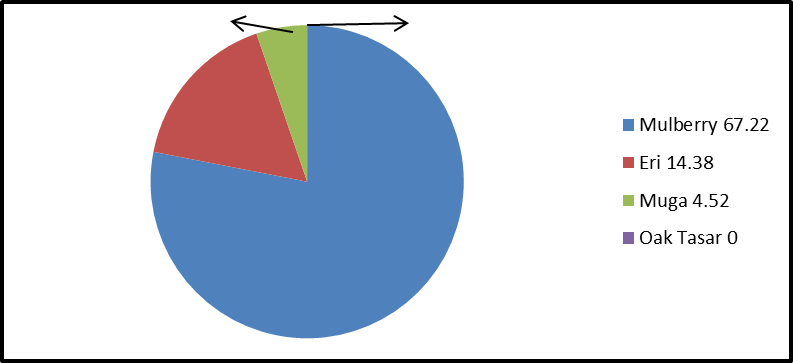
1 | Mulberry | 95 | 67.22 |
2 | Eri | 16 | 14.376 |
3 | Muga | 7 | 4.52 |
4 | Oak-tasar | 1 | - |
| Total | 119 | 86.116 |
District wise Raw silk production of the year 2024-25:
Name of the District | Production of Raw silk (MT) | ||||||
Mulberry | Vanya | ||||||
BV | CB | Total | Eri | Muga | Oak-Tasar | Total | |
Aizawl | 8.41 | 2.45 | 10.86 | 1.08 | 0.46 | - | 23.26 |
Lunglei | 15.81 | 4.62 | 20.43 | 1.44 | 0.52 | - | 42.82 |
Siaha | - |
|
| 0.144 | 1.29 | - | 1.434 |
Champhai | 11.91 | 1.43 | 13.34 | 1.224 | 0.14 | - | 28.044 |
Kolasib | 0.5 | 1.06 | 1.56 | 1.08 | 0.52 | - | 4.72 |
Serchhip | 1.92 | 1.15 | 3.07 | 0.57 | 0.27 | - | 6.98 |
Lawngtlai | 3.16 | 0.92 | 4.08 | 1.008 | 0.18 | - | 9.348 |
Mamit | 1.41 | 0.41 | 1.82 | 6.48 | 0.2 | - | 10.32 |
Saitual | 1.29 | 0.69 | 1.98 | 0.288 | 0.14 | - | 4.388 |
Khawzawl | 5.36 | 2.72 | 8.08 | 1.29 | 0.1 | - | 17.55 |
Hnahthial | 1.98 | 0.02 | 2 | 0.772 | 0.7 | - | 5.472 |
Total | 51.75 | 15.47 | 67.22 | 14.376 | 4.52 | - | 153.336 |
The consumption of dfls, Production of reeling cocoons and production of raw silk of Mizoram for the year 2024-2025 are as given in the table below:
# |
Sector | Dfls (L/ no) | Cocoon production
| Raw silk production (MT) |
1 | Mulberry | 12.82 | 597.306 MT | 67.22 |
2 | Eri | 2 | 17.97 MT | 14.376 |
3 | Muga | 6.8 | 272.04 Lakh nos | 4.52 |
4 | Oak-Tasar | - | - | - |
The graphical presentation of raw silk production during 2024-2025:
Mulberry 67.22 |
Oak Tasar 0 |
Muga 4.552 |
Eri 14.38 |
- Raw silk production of state for last 5 years:
# | Variety |
2020-21 |
2021-22 | 2022-23 | 2023-24 | 2024-25 | 2025-26 |
| Target | ||||||
I | Mulberry Raw Silk (MT) |
|
|
|
|
|
|
| Bivoltine | 33.47 | 38.86 | 53.6 | 51.62 | 51.75 | 76 |
| Cross Breed | 4.022 | 11.15 | 15.98 | 16.56 | 15.47 | 21 |
| Mulberry Total | 37.488 | 50.01 | 69.58 | 68.18 | 67.22 | 97 |
II | Vanya Silk (MT) |
|
|
|
|
|
|
| Eri | 5.216 | 6.967 | 10.965 | 11.486 | 14.376 | 21 |
| Muga | 0.285 | 1.998 | 3.493 | 3.863 | 4.52 | 8 |
| Oak-Tasar | 0.023 | 0.24 | 0.006 | 0.006 | - | 0.2 |
| VanyaTotal | 5.524 | 9.205 | 14.464 | 15.355 | 18.896 | 29.2 |
| Grand Total (M+V) | 43.012 | 59.215 | 84.044 | 83.535 | 86.116 | 126.2 |
Number of Active Reelers, Spinners, Weavers, Dyers and Spinning Mills:
Reelers | Spinners | Weavers | Dyers | Spinning Mills |
3 | 18 | 36 | - | - |
Employment generation (No. of persons) as on 31st March 2025:
Category | Male | Female | Total |
(a) On - farm | 22 | 5 | 27 |
(b) Reeling | 6 | 3 | 9 |
(c) Yarn to fabrics (optional) | - | 36 | 36 |
Total | 28 | 47 | 72 |
Productivity:
Year | Productivity of Reeling cocoon kg/100 dfls | Productivity of Raw silk Kg / Acres | ||||||
Mulberry | Eri | Muga | Oak-tasar | Mulberry | Eri | Muga | Oak-tasar | |
2012-13 | 6 | 8 | 1653 nos. | 393 nos. | 8 | 15 | 2.00 | 2.00 |
2013-14 | 46.4 | 10.5 | 7062 nos. | 2235 nos. | 14.5 | 28.8 | 5.9 | 87.5 |
2014-15 | 44.0 | 9.5 | 3315 nos. | 3354 nos. | - | - | - | - |
2015-16 | 41.4 | 9.5 | 3433 nos. | - | - | - | - | - |
2016-17 | 43.76 | 8.95 | 1623 nos. | 1900 nos. | 16.23 | 14.4 | 0.43 | 0.13 |
2017-18 | 57.16 | 9.47 | 4331 nos. | 5667 nos. | 18.33 | 10.46 | 1.18 | 0.41 |
2018-19 | 45.26 | 9.01 | 4000 nos. | 4000 nos. | 19.85 | 10.54 | 1.23 | 0.42 |
2019-20 | 46.75 | 9.0 | 4002 nos. | 2987 nos. | 22.22 | 9.14 | 3.75 | 1.17 |
2020-21 | 48.81 | 9.0 | 4003 nos. | 4001 nos. | 20.21 | 8.12 | 2.34 | 0.67 |
2021-22 | 48.10 | 9.0 | 4003 nos. | 4002 nos. | 22.63 | 28.8 | 1.33 | 1.14 |
2022-23 | 48.10 | 9.0 | 4003 nos. | 4002 nos. | 22.63 | 28.8 | 1.33 | 1.14 |
2023.24 | 48.10 | 9.0 | 4003 nos. | 4002 nos. | 22.63 | 28.8 | 1.33 | 1.14 |
2024-25 | 48.10 | 9.0 | 4003 nos. | 4002 nos. | 22.63 | 28.8 | 1.33 | 1.14 |
Infrastructure:
The following infrastructure facilities are available in Sericulture Industry in Mizoram:
Sector | Infrastructure facilities
| Under state | Name of Location | Under CSB |
Muga | Muga P2 seed farm | 05 | 1. Kolasib 2. Kawnpui 3. Darlawn 4. Mamit 5. Thenzawl |
|
Eri | Basic Seed farm | 02 | 1. Kolasib 2. Lengpui |
|
Mulberry | Research Extension Center | 01 | 1.Aizawl |
|
P2 Seed Farm (Rangvamual )
| 01
| 1.Rangvamual
|
| |
Seed Multiplication Farm | 08 | 1. Seling 2. Lunglei 3.Champhai 4. Vairengte 5. Thenzawl 6. Serchhip 7. Hnahthial 8. Phullen | REC(Aizawl) | |
Grainage Centre
| 04
| See next page |
| |
Multiend Reeling unit | 03 | 1. Zemabawk 2. Champhai 3. Zobawk |
| |
Oak-tasar | Seed Farm | 01 | 1.Champhai |
|
Others | Silk Weaving Centre (Pvt.) | 03 | 1.Bombyx Choice 2. Lenbuang 3. Zozia |
|
Sericulture Training Institute | 01 | 1.STI Zemabawk |
| |
Reeling and Spinning Centre | 01 | 1. Zemabawk
|
| |
Silk Weaving Centre (Dept.) | 02 | 1.Aizawl 2.Kolasib |
| |
Cocoon market
| 02
| 1. STI Zemabawk 2.Chaltlang |
| |
Sales Emporium
| 01
| 1.Chaltlang |
| |
Cold Storage
| 02
| 1. STI Zemabawk 2.Hnahthial
|
| |
Solar Plant: 5 kVp 10 kWp 20 kWp Total | 01 03 03 07 | 1.Rangvamual 2.Thenzawl 3.Mamit 4.Lunglei 5.STI Zemabawk 6.Hnahthial 7.Directorate |
|
Seed production infrastructure facilities of Mizoram:
Sector: Muga.
Muga Seed Production infrastructure | ||||||
Sl. No.
| Name of the Grainages
| Year of establishment | Food plant area | Available plantation | Effective plantation | Seed Prodn. capacity/yr (lakhs nos) |
Acres | Acres | Acres | Dfls | |||
1
| Muga seed Farm, Kawnpui, District – Kolasib. | 1974 | 2 | 10 | 8 | 1.2 |
2 | Muga Seed Farm, Kolasib, District – Kolasib. | 2002 | 3 | 5 | 3 | 0.65 |
3 | Muga Seed Farm, Darlawn, District - Aizawl | 1982 | 7 | 5.5 | 1.5 | 0.4 |
4 | Muga seed Farm, Mamit District Mamit | 1976 | 27.25bghs | 2.5 | 2.5 | 0.6 |
5 | Muga Seed Farm, Thenzawl, District - Serchhip | 2014 | 1 | 1 | 1 | 0.3 |
6 | Commercial Grainage Centre, Durtlang | 2017 |
|
|
| 1.0 |
TOTAL |
|
|
| 4.15 | ||
Sector: Eri
Eri Seed Production infrastructure | ||||||
Sl. No.
| Name of the Grainages | Year of establish ment | Technical building | Available plantation | Effective plantation | Seed Prodn. capacity/yr |
No | Acres | Acres | Lakh nos. | |||
1
| Govt.Eri Seed Farm, Kolasib, Dist.Kolasib | 1974 | 2 | 4.5 | 3 | 1.0 |
2 | Govt. Eri Seed Farm, Lengpui, Dist. Aizawl. | 1980 | 2 | 5 | 2.5 | 1.0 |
TOTAL |
|
|
| 2.0 | ||
Sector: Mulberry
Mulberry Seed Production infrastructure | ||||||
Sl. No. | Name of the Grainages | Year of establish- ment | Technical building | Available plantation | Effective plantation | Seed Prodn. capacity/yr |
No | Acres | Acres | Dfls | |||
1
| Grainage centre, Zemabawk. | 2003 | 4 | - | - | 5 lakhs |
2 | Grainage Centre, Zobawk. | 2006 | 3 | - | - | 3 lakhs |
3 | Grainage Centre, Champhai | 2018 | 1 | - | - | 2 lakhs |
4 | Grainage Centre, Hnahthial | 2018 | 1 | - | - | 3 lakhs |
| Total |
| 7 |
|
| 13 lakhs |
Note: GCs are not producing Seed Cocoon but procured cocoon from Govt’ Seed farms and also purchased from Pvt. Seed Growers.
Sector: Tasar
Tasar Seed Production infrastructure | ||||||
Sl. No. | Name of the Grainages | Year of establish- ment | Technical building | Available plantation | Effective plantation | Seed Prodn. capacity/yr |
No | Acres | Acres | Dfls | |||
1
| Oak Tasar Seed Farm, Tlangsam District Champhai | 1975 | 3 | 20 | 19 | 0.30lakhs |
Financial Progress:
The scheme wise financial allocation for the Department of Sericulture, Govt. of Mizoram for development of Mulberry, Eri, Muga and Oak-tasar for the year 2024-2025.
(Rs. in lakh)
# | Name of the plan/scheme | Financial allocation For 2024-2025 | Total Expenditure |
1.
| State Plan Programme
| 175.87 1468.71 5.50 19.14 16.42 - - - | 132.26 1409.4 0.5 9.41 16.37 - - - |
| Total | 1685.64 | 1567.97 |
Financial allocation:
Year-wise financial allocation to Mizoram under for the year shown in break-up below:
2024-2025
(Rs. In lakh)
Sl.No | Project/ Scheme/Plan | Source of Fund | Name of the plan/Scheme | Financial Allocation for 2024-2025 | Total Expenditure |
1
| Rashtrya Krishi Vikas Yojana (RKVY) | Agri | Ericulture under RKVY | 760.00 | 197.25 |
2 | Silk Samagra 1 & 2 under Central Sector Scheme | CSB/ MoT | Eri Silk Development Project | 792.74 | -NIL- |
3 | Silk Samagra -II | CSB/ MoT | Augmentation of Muga Culture | 721.84 | -NIL- |
Beneficiaries covered under different schemes of Govt of India:
Scheme | Project Name | Beneficiaries covered | Project completion report submitted to CSB (Yes/No) |
NERTPS | Integrated Sericulture Development Project | 600 | Yes |
Intensive Bivoltine Sericulture Development Project for Mulberry in Mizoram | 1000 | Yes | |
Integrated Muga Silk Project under NERTPS of Govt. of India in Kolasib District of Mizoram
| 500 | Yes | |
Development of Eri culture in Mizoram for upliftment of Aspirational District. Mamit District | 500 | Yes | |
Silk Samagra-2 | Eri Silk Development Project in Mizoram under Silk Samagra-2 | 500 |
|
Sustainable Livelihood Through Ericulture in East Mizoram | 300 |
| |
Expansion of silk industry by upgradation of Sericulture Complex at Zemabawk, Aizawl, Mizoram | Civil Works |
| |
Development of Rural Lai Autonomous District | 100 |
| |
Development of Rural Chakma Autonomous District Council through Mulberry Sericulture in Mizoram | 100 |
| |
Augmentation of Muga culture in Mizoram | 500 |
| |
Livelihood Promotion through Ericulture in Mizoram | 120 |
|
Status of ongoing sericulture Scheme by Govt. of India:
Silk Samagra-2:
Sl No | Project Name | Total Project Cost | GoI Share | GoI Share Released | Fund Utilized | Fund Un-utilized |
1 | Eri Silk Development Project in Mizoram under Silk Samagra-2 | 1718.17 | 1573.60 | 1481.99 | 1451.51 | 30.48 |
2 | Sustainable Livelihood Through Ericulture In East Mizoram | 1487.25 | 1361.05 | 1114.91 | 1048.90 | 66.01 |
3 | Expansion of silk industry by upgradation of Sericulture Complex at Zemabawk, Aizawl, Mizoram |
|
|
|
|
|
4 | Development of Rural Lai Autonomous District | 616.48 | 563.19 | 384.31 | 228.33 | 155.99 |
5 | Development of Rural Chakma Autonomous District Council through Mulberry Sericulture in Mizoram | 580.81 | 530.42 | 502.71 | 314.05 | 188.66 |
6 | Augmentation of Muga culture in Mizoram | 1339.61 | 1226.36 | 1148.08 | 772.47 | 375.61 |
7 | Livelihood Promotion through Ericulture in Mizoram | 265.72 | 241.84 | 224.20325 | - | 224.20325 |
GOVT. APPROVED RATE OF SERICULTURE PRODUCTS VALID UPTO 01.01.2025-01.01.2028 (MINIMUM PRICE)
- MULBERRY
Renditta | Race (Bi x Bi) | Race (M x Bi) |
6.1 – 6.9 | Rs. 400/- per kg | Rs. 370/- per kg |
7 – 7.9 | Rs. 350/- per kg | Rs. 300/- per kg |
8 – 8.9 | Rs. 300/- per kg | Rs. 250/- per kg |
9 – 9.9 | Rs. 250/- per kg | Rs. 200/- per kg |
10 & above | Rs. 200/- per kg | Rs. 170/- per kg |
Waste | Rs. 150/- per kg | Rs. 140/- per kg |
Seed Cocoon | Rs. 450/- per kg | Rs. 450/- per kg |
- MUGA
Sl/No | Description | Purchasing Price |
1 | Seed Cocoon | Rs. 3/-per Cocoon |
2 | Reeling Grade A | Rs. 2.0/-per Cocoon. |
3 | Waste | Rs. 120/-per kg. |
- ERI
Sl/No. | Description | Purchasing Price |
1 | Seed Cocoon | Rs. 2/-per Cocoon |
2 | Hand Open | Rs. 700/-per kg. |
3 | Cut Cocoon | Rs. 550/-per kg |
4 | Pierce/Flimsy / Stain | Rs. 300/-per kg |
5 | Pupa | Rs. 300/-per kg |
- OAK TASAR
Sl/No. | Description | Purchasing Price |
1 | Seed Cocoon | Rs. 2/-per Cocoon |
2 | Reeling Cocoon A Grade | Rs. 1.50/-per Cocoon |
3 | Reeling Cocoon B Grade | Rs. 1/- per Cocoon |
4 | Waste Cocoon | Rs. 0.50/- per kg |
- SILK YARN RATE
Sl.No. | Description | Purchasing Price |
1. | Mulberry Raw Silk (Bivoltine) | Rs. 3400/- per kg |
2. | Mulberry Raw Silk (Multivoltine) | Rs. 3200/- per kg |
3. | Bleached Yarn (Bivoltine) | Rs. 4200/- per kg |
4. | Bleached Yarn (Multivoltine) | Rs. 4000/- per kg |
5. | Mulberry Dyed Yarn | Rs. 5500/- per kg |
6 | Muga Yarn | Rs. 15000/- per kg |
7 | Eri Silk Yarn | Rs. 2200/- per kg |
- MULBERRY TWISTED YARN
Sl.No. | Description | Purchasing Price |
1. | Bivoltine | Rs. 4,200/- per kg |
2. | Multivoltine | Rs. 4,000/- per kg |
- DISEASE FREE LAYING
Sl.No. | Description | Minimum Selling Price | Actual Selling Price (subsidized rate) |
1. | Mulberry Dfls. | Rs. 7/- per Dfls. | Rs. 5/-per Dfls. |
2. | Muga Dfls. | Rs. 14/- per Dfls. | Rs. 5/-per Dfls. |
3. | Eri Dfls. | Rs. 7/- per Dfls. | Rs. 7/-per Dfls. |
4. | Oak Tasar Dfls. | Rs. 10/- per Dfls. | Rs. 6.50/-per Dfls. |
Attachment